
The 60-Second Answer
Wisdom tooth extraction pain and recovery time depend mainly on one thing: how your tooth is sitting inside your jaw. It is not the same for everyone.
If your wisdom tooth — called Gyana Danta in Odia — has already erupted and is loose, removal is usually quick and simple. Many patients feel back to normal within a day.
If the tooth is impacted — angled, trapped under gum or bone — the extraction is surgical, and swelling or discomfort can last 3 to 4 days before it clearly improves.
Neither case is unusual. The only way to know which one applies to you is an X-ray and a proper checkup — not guesswork based on what happened to a friend or relative.
Why Some Cases Hurt More Than Others
Most of the fear around wisdom tooth removal comes from hearing one bad story and assuming every extraction is like that. In reality, there are two very different situations, and they lead to very different recoveries.
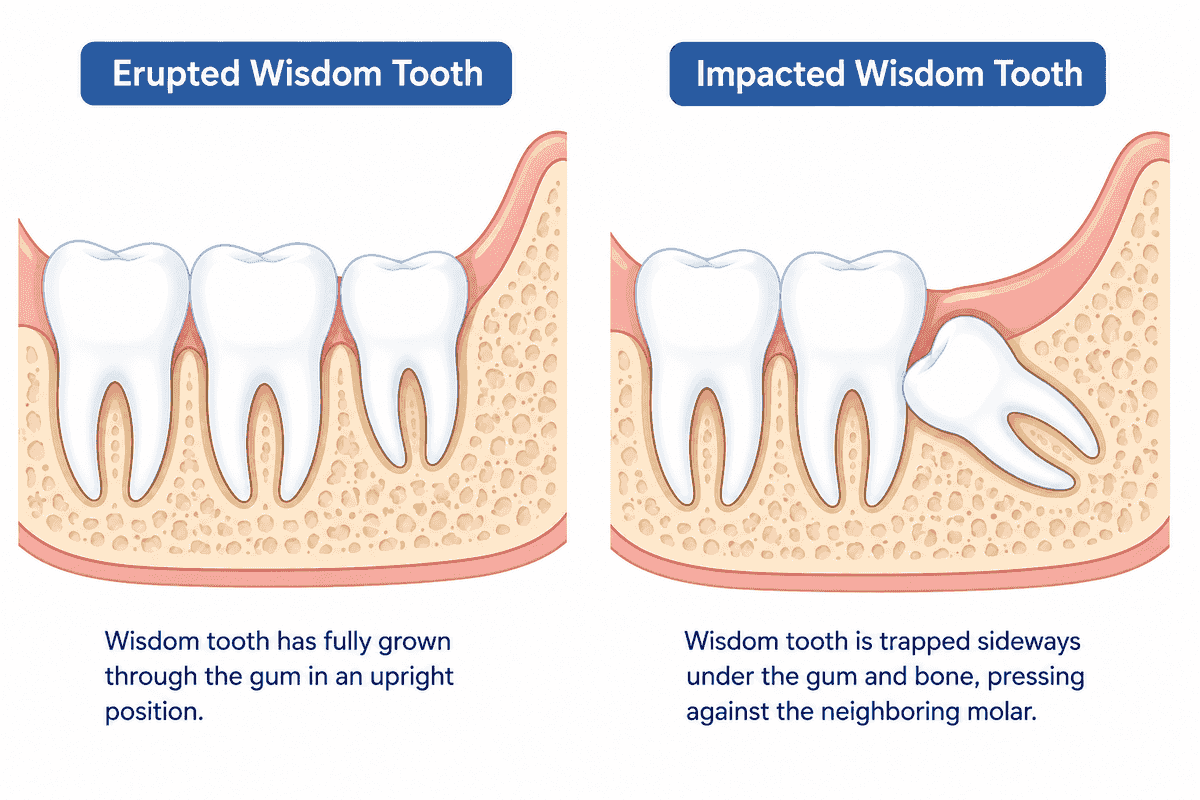 Erupted vs. impacted wisdom tooth — the difference that determines whether your extraction is simple or surgical.
| Erupted & loose tooth | Impacted tooth | |
|---|---|---|
| What’s happening | Already through the gum, not trapped in bone | Stuck against bone, gum, or the neighboring tooth |
| Extraction type | Simple — removed like any other tooth | Surgical — a small procedure to safely free it |
| Pain & swelling | Minimal | More significant, naturally |
| Recovery | Faster | Longer healing window |
Dentists classify impacted wisdom teeth by the direction they’re angled:
- Mesial (angled forward): The most common type. The tooth leans toward the front of the mouth and pushes into the molar next to it.
- Distal (angled backward): The least common type. The tooth leans toward the back of the mouth.
- Vertical (straight, but trapped): The tooth is upright and pointed the right way, but there isn’t enough room for it to fully come through.
- Horizontal (sideways): The tooth is lying on its side, pressing directly into the tooth next to it. This is usually the most involved type to remove.
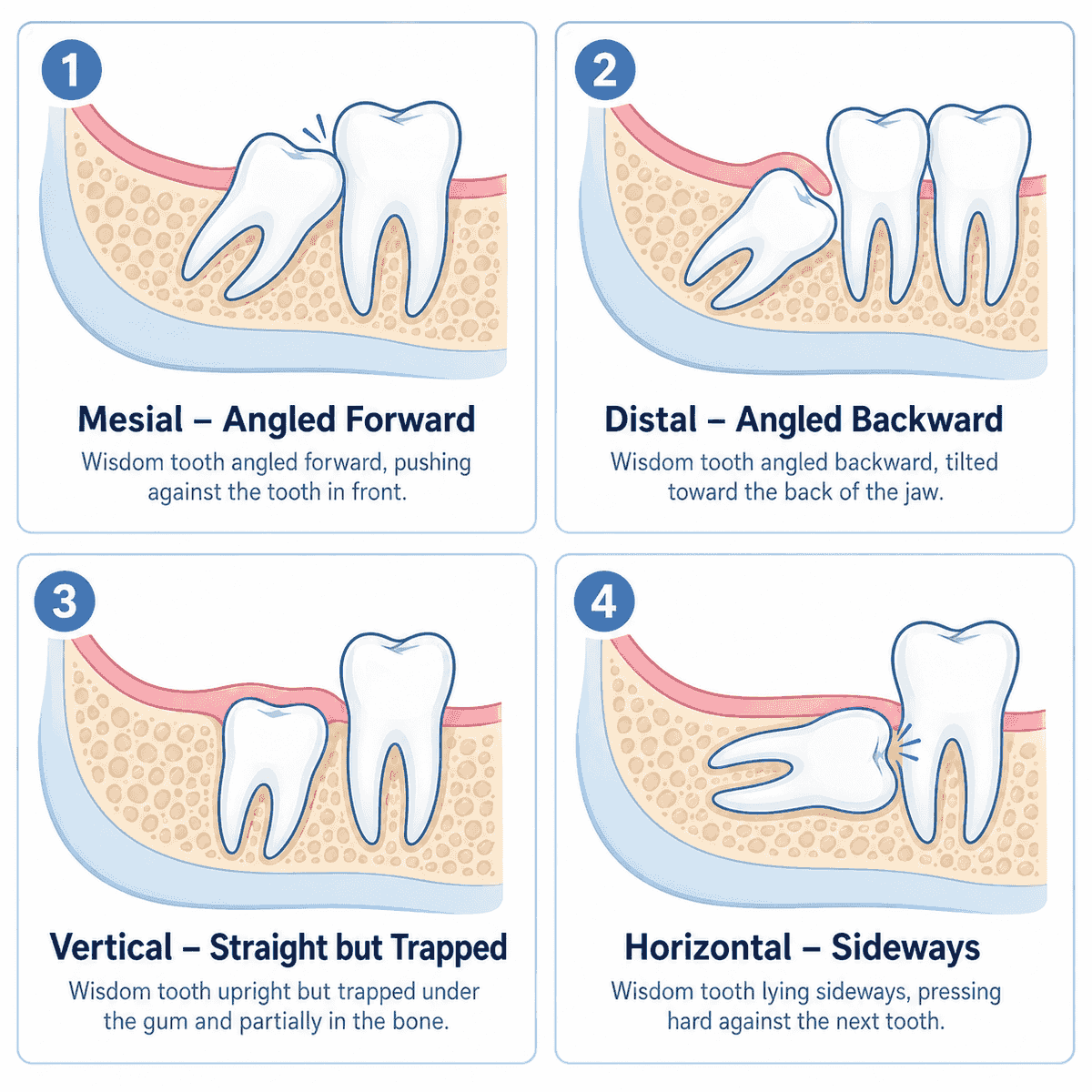 The four impaction angles — your dentist identifies which one applies to you from an X-ray.
One more thing worth knowing: removing a wisdom tooth earlier — in the teenage years or early twenties — is generally easier than waiting, because the roots aren’t fully formed and the surrounding bone is softer. This isn’t a hard rule for every patient, but it’s a pattern dentists commonly see.
A Harder Extraction Doesn’t Mean a Less Skilled Dentist
Here’s something worth saying plainly: how much pain or difficulty you experienced has nothing to do with how capable your dentist is.
It’s a natural instinct — if the extraction was tough, took longer, or hurt more than a friend’s did, it’s tempting to wonder if something went wrong or if a “better” dentist would have made it easier. But that comparison misses what’s actually happening. A mesial impaction and a horizontal impaction are simply different procedures on different anatomy. One genuinely requires more time, more precision, and sometimes removing a small amount of bone to safely free the tooth. That’s not a reflection of skill — it’s a reflection of what your particular tooth was doing inside your jaw before the dentist ever touched it.
If anything, a harder case handled carefully — with proper anesthesia, controlled technique, and clear aftercare instructions — is a sign of a dentist doing the job correctly, not poorly. The tooth’s position was decided by your anatomy long before you walked into the clinic.
This is also why the charges for a surgical, impacted extraction are usually higher than for a simple one. It isn’t an arbitrary number — it reflects the actual additional time, skill, and sometimes equipment involved in safely removing a tooth that isn’t sitting where it should. A straightforward extraction and a surgical one are genuinely different procedures, and the fee difference reflects that difference honestly.
Day-by-Day Recovery Timeline
This is the part most people actually want to know: how many days will I actually be uncomfortable?
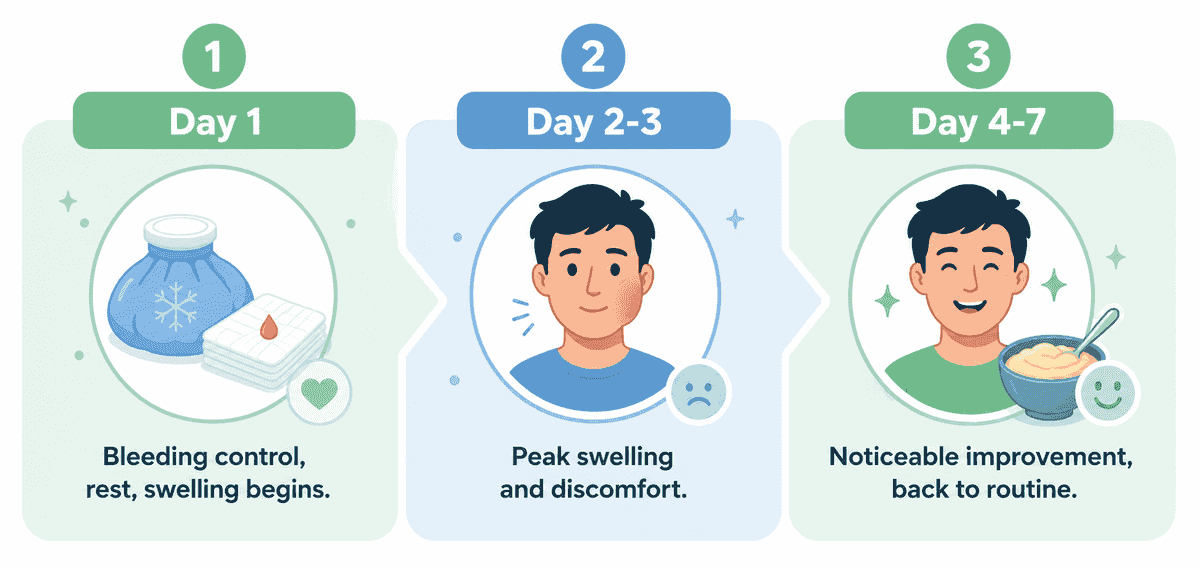 Save this: the general recovery pattern for a surgical (impacted) wisdom tooth extraction.
| Day | What’s happening |
|---|---|
| Day 1 | Bleeding control is the main job. Bite on gauze for 30–60 minutes right after the procedure, rest with your head slightly raised, and don’t skip your first pain relief dose — take it before the numbness fully wears off. Swelling usually starts today. |
| Day 2–3 | The peak — the “3 to 4 days” window most patients notice the most. Swelling and discomfort are at their highest, then start easing. Salt water rinses can begin gently from Day 2 onward. |
| Day 4–7 | Noticeable improvement. Most people are back to soft foods and a normal routine by now, and pain should be steadily decreasing, not increasing. |
If your tooth was already loose or fully erupted, you may skip most of this timeline entirely and feel close to normal within a day or two. The days above mainly apply to surgical, impacted-tooth extractions.
One important flag: pain that gets worse after Day 3, instead of better, is not normal — that pattern (along with a bad taste or visible empty-looking socket) can point to dry socket, and you should call your dentist rather than wait it out.
What To Do — and What To Avoid
Do:
- Apply an ice pack in 15-minutes-on, 15-minutes-off intervals for the first day to control swelling
- Stick to soft, cool foods (curd, khichdi, soup, smoothies without a straw)
- Start gentle salt water rinses from Day 2
- Take prescribed painkillers/antibiotics on schedule — don’t wait for pain to get bad
- Rest with your head slightly elevated for the first 24 hours
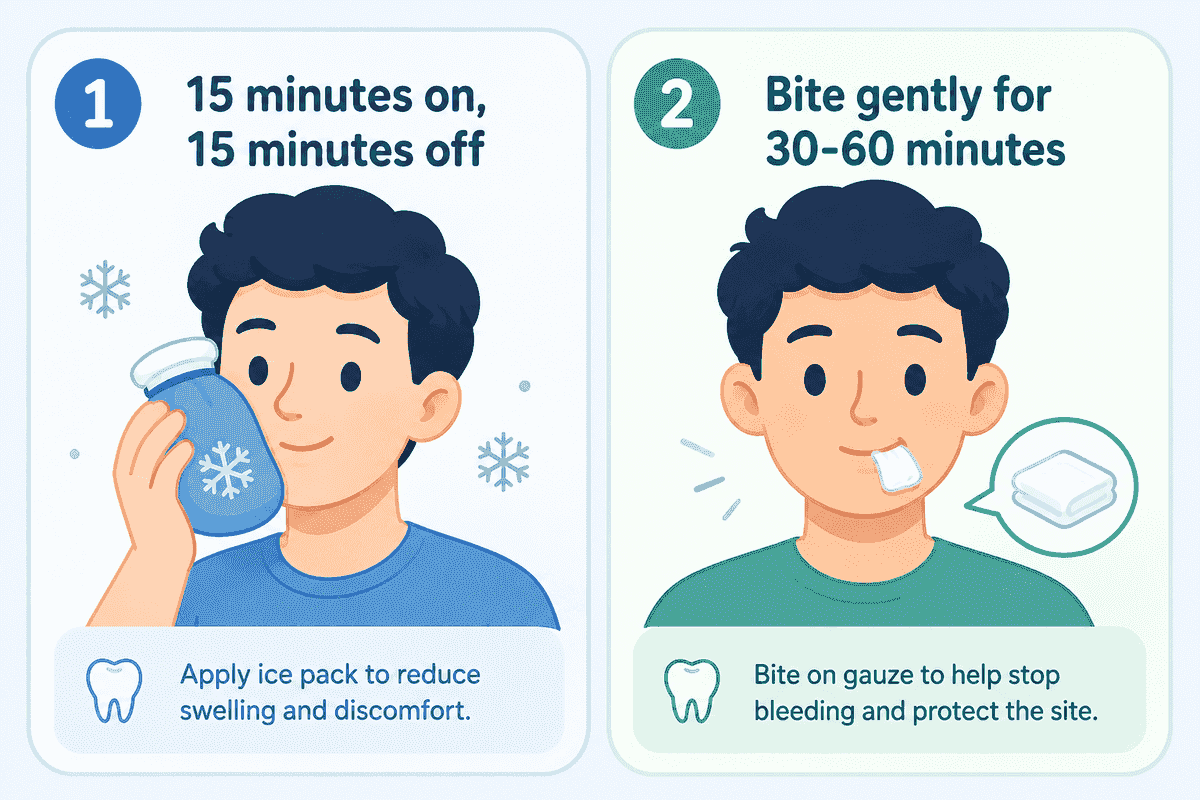 The two most important things to get right in the first few hours after your extraction.
Avoid:
- Straws — the suction can dislodge the healing clot
- Spitting forcefully or rinsing hard on Day 1
- Hard, crunchy, or chewy foods for the first week
- Touching or poking the extraction site with your tongue or fingers
- Strenuous activity or exercise for the first couple of days
Extra Care If You Smoke, Drink, or Chew Gutkha/Pan Masala
If any of these are part of your routine, your healing site needs a bit more protection than the general advice above covers.
| Habit | Recommended break | Why it matters |
|---|---|---|
| Smoking | At least 3 days, ideally the full first week | The suction from inhaling can pull the healing clot loose, and nicotine reduces blood flow to the area, slowing healing even without the suction issue. |
| Alcohol | 3–7 days, and strictly avoid while on any prescribed antibiotic course | Thins the blood and can interfere with the clot forming, raising the risk of prolonged bleeding or dry socket. Some antibiotic-alcohol combinations cause real problems, not just an upset stomach. |
| Gutkha, pan masala, or tobacco chewing | 2 to 4 weeks — the longest break of the three | The chewing action puts direct pressure on the healing socket, and the tobacco and lime (chuna) in these products irritate the raw tissue directly. |
None of this is about judgment — it’s simply that these habits interact directly with how your body forms and protects the healing clot. If you’re upfront with your dentist about your habits beforehand, they can plan your aftercare instructions around it specifically.
Myths — Busted
“Everyone needs all 4 wisdom teeth removed.” False. Removal is only needed if a tooth is impacted, causing pain, or likely to cause problems later. Some wisdom teeth — especially vertical ones with enough room — never need to come out.
“It’s always painful.” False. As covered above, this depends entirely on whether the tooth is erupted or impacted. Many simple extractions cause barely any discomfort.
“You can’t eat for a week.” False. Soft foods are perfectly fine within the first couple of days. You’re avoiding hard and chewy foods, not all food.
“Dry socket happens to everyone.” False — dry socket is a real but far from universal complication, and it’s strongly linked to smoking, straw use, and disturbing the clot early. Following aftercare instructions makes it unlikely.
A Patient’s Take
One of our patients summed up his impacted wisdom tooth recovery a little too honestly on his WhatsApp status:
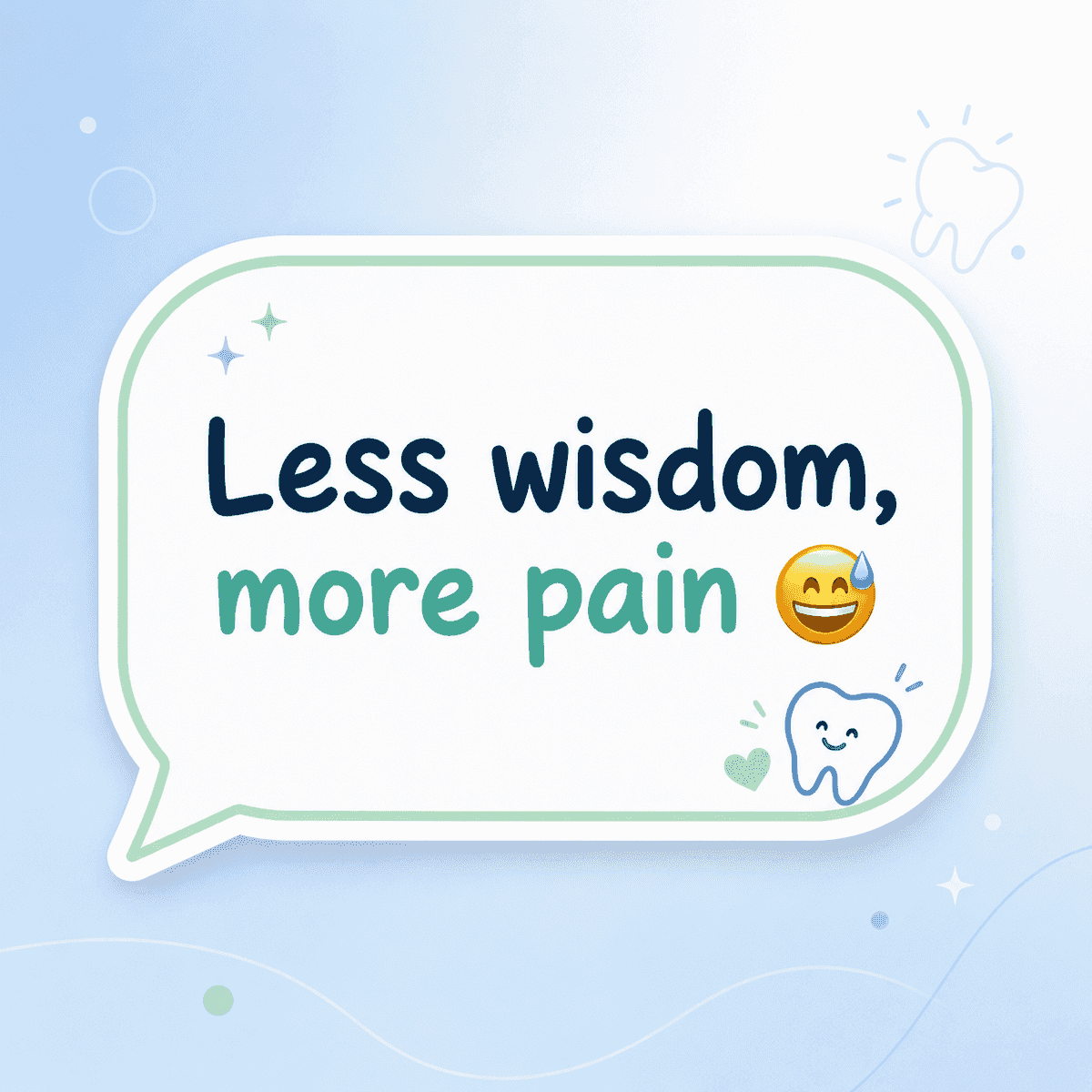
Fair enough — impacted extractions aren’t always fun in the first few days. But as the timeline above shows, that’s the harder end of the spectrum, not the only outcome.
Sources
Claims in this article are based on published guidance from Cleveland Clinic, and dental practice resources on impaction types, recovery timelines, and aftercare (including tobacco/alcohol interactions with healing). This article is educational and doesn’t replace an in-person dental evaluation.
Find Out Before It’s a Problem
The only way to know whether your wisdom tooth will be a simple extraction or a surgical one is an X-ray. Book a consultation at Tooth Korner, Deogarh, and we’ll tell you exactly what to expect — before you’re already anxious about it.